Skip search and go to the page content
Wegmark

Materials

Five things get sold as leather. Only two of them are a hide you would want.

In Germany, describing leather inaccurately is an unfair commercial practice and a competitor can act on it. We think that is the right rule, so every Wegmark product page names the exact grade, the layer of the hide and the tanning method. This page explains what those words mean, including on other people’s sites.

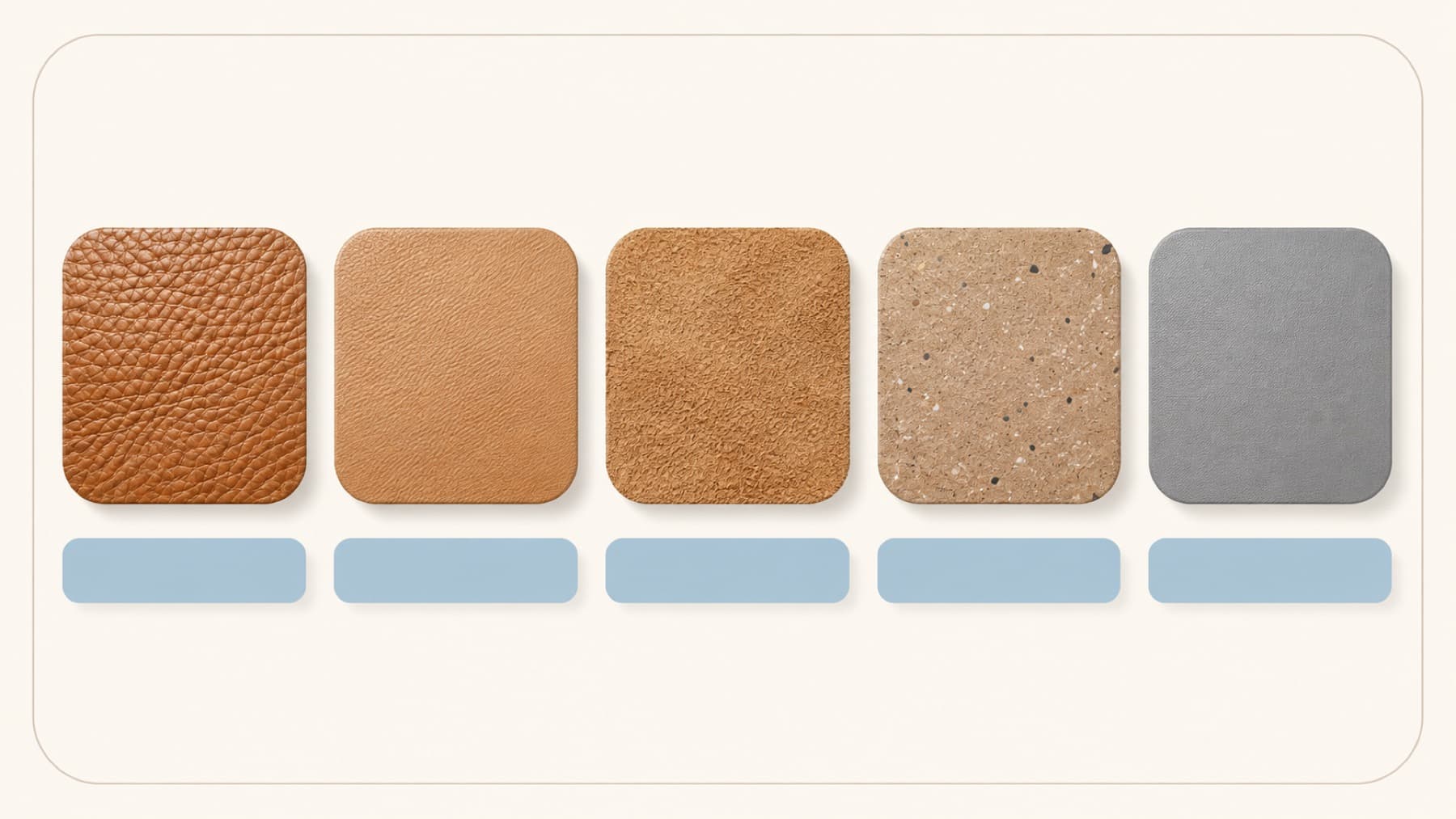
Five leather swatches in a row: full-grain, top-grain, split, recycled bonded fibre and synthetic

01

Full-grain

Vollnarbenleder

What it is
The outermost layer of the hide with its natural grain intact — nothing sanded off, nothing embossed on.
How it behaves
The tightest, strongest fibre structure in the hide. It does not peel, because there is no coating to peel. It develops a patina.
How to tell
Visible pores, healed scars and insect marks. No two panels identical. The surface reflects light unevenly.

02

Corrected top-grain

Rindsleder (narbenkorrigiert)

What it is
Also the top layer, but lightly sanded to even out marks and then pigmented and finished.
How it behaves
A more uniform surface that takes a water-repellent finish well. We use it where a finish matters more than patina — wash bags, mostly.
How to tell
Even colour and a slight surface film. Still strong, still the top layer, but it will not patina the way full-grain does.

03

Split leather

Spaltleder

What it is
The layer beneath the grain, split off during processing. Suede is usually made from this.
How it behaves
Softer and cheaper, with a looser fibre structure and lower tear strength.
How to tell
A fibrous, napped surface on both faces. If a shop calls this "genuine leather" without saying "split", read the rest of the listing carefully.

04

Recycled bonded leather fibre

Recyceltes Leder

What it is
Leather offcuts shredded to fibre and bonded into a sheet, usually with latex.
How it behaves
A real use for tannery waste, and dimensionally very stable. But it is a reconstituted board, not a hide.
How to tell
Perfectly uniform thickness with a flecked cut edge. It can crack along a repeated fold.

05

Synthetic

Kunstleder / PU

What it is
A polymer coating on a textile backing. No hide involved at any stage.
How it behaves
Cheap, uniform and genuinely impervious to water. It also delaminates within a few years and cannot be repaired. We do not use it anywhere in the range, and no claim on this site about water resistance refers to it.
How to tell
Absolutely uniform surface, a textile weave visible on the reverse, a plastic smell when new.

Vegetable tanning

Tannins from bark and plant matter, in pits, over weeks. The result is firm, holds a shaped fold, smells of leather rather than chemicals, and darkens with light and handling. Most of the catalogue is vegetable-tanned, which is why a passport cover bought this spring will not match one bought next spring — and why that is the point.

Chrome tanning

Chromium salts, in drums, over a day. Softer, more supple, more colour-stable, and it accepts a water-repellent finish that vegetable-tanned leather will not hold. We use it for the wash bags and the split laundry pouch, where wiping something clean matters more than a patina.

Chemicals, sourcing and the claims we do not make

Chromium VI

REACH Annex XVII limits chromium VI in leather articles that come into contact with skin to 3 mg/kg. Our tanneries certify at or below that limit, and supplier declarations are held on file and available to authorities on request.

Azo dyes

The REACH restrictions on azo dyes that can release listed aromatic amines are observed throughout the range. Certificates form part of the same supplier documentation.

Animal sourcing

Bovine hide obtained as a by-product of the food industry. No CITES-listed species, no exotic skins such as crocodile, python or stingray, and no fur of any kind.

Allergies

Tanning agents, dyes and finishes can cause contact allergies in a small number of people. We do not describe any product as hypoallergenic. If your skin reacts, stop using the item and seek advice.

Water resistance

Where an item has a repellent finish we say "water-repellent" and describe its limit. Nothing we sell is waterproof: seams and stitch holes are not sealed, and the finish wears down with use.

Design origin

Original or generic patterns only. No third-party logos, monograms, canvas patterns or designs that imitate another brand appear anywhere in the range.

Three items in this shop are not leather

It would be easy to leave these described vaguely. Instead each one states its real material on its own product page:

Next: how to look after it or the whole catalogue.

HMT Lederwaren Import GmbH, Eichenstraße 56, 65933 Frankfurt am Main, Germany